
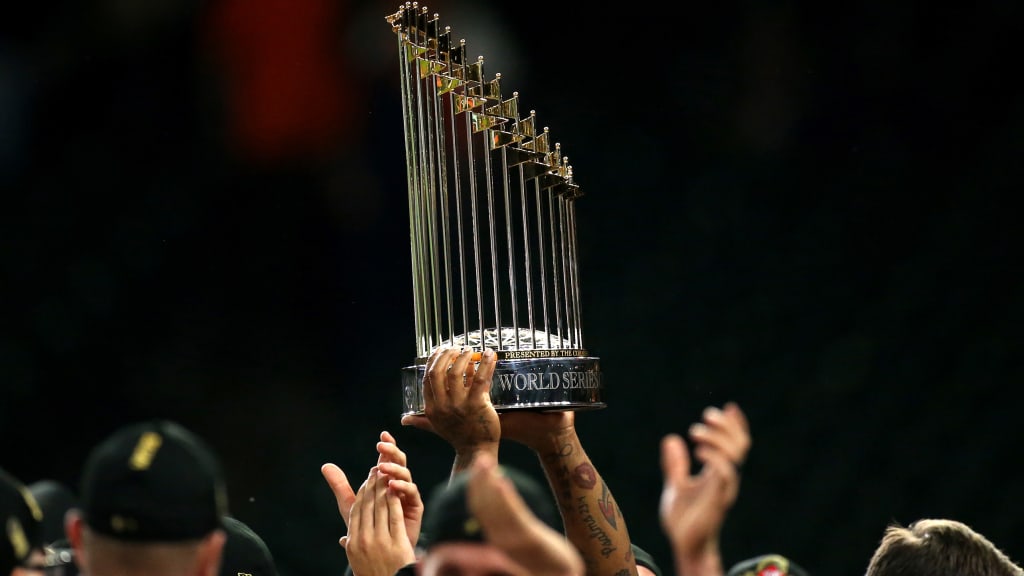
Over the years, home-field advantage in the World Series has been decided in different ways. But these days, it's pretty simple.
- The team with the higher regular-season win percentage earns the home field, regardless of whether that team won its division title or a Wild Card berth. That means playing host to Games 1-2 and 6-7 (if necessary).
- If two teams have the same regular-season win percentage, the tiebreaker is head-to-head record, which is possible now that every team faces every other team in at least one series.
Here is a look at the final four teams in the 2026 postseason field, ranked by home-field advantage priority. In other words, whichever team is ranked higher on this list earns home field.
1. Milwaukee Brewers: 103-59, .636
2. Los Angeles Dodgers: 100-62, .617
3. Tampa Bay Rays: 98-64, .605
4. Cleveland Guardians: 85-77, .525
The Brewers, Dodgers and Rays finished the three best records in the Majors, while the Guardians ranked 11th. With Milwaukee and Los Angeles finishing ahead of Tampa Bay and Cleveland, it's now guaranteed that the NL team will have home-field advantage in the World Series.
What is the series schedule?
Here is the schedule for the 122nd Fall Classic, with each game broadcast on FOX and FOX One. Game times have yet to be announced.
Game 1: Friday, Oct. 23 (AL champion at NL champion)
Game 2: Saturday, Oct. 24 (AL champion at NL champion)
Game 3: Monday, Oct. 26 (NL champion at AL champion)
Game 4: Tuesday, Oct. 27 (NL champion at AL champion)
Game 5: Wednesday, Oct. 28* (NL champion at AL champion)
Game 6: Friday, Oct. 30* (AL champion at NL champion)
Game 7: Saturday, Oct. 31* (AL champion at NL champion)
*If necessary
How much does home field matter?
Not as much as you might think.
On one hand, teams with World Series home-field advantage in the Wild Card Era (since 1995) have gone on to win the championship 20 of 30 times (67%), excluding the 2020 World Series played at a neutral site. But when it comes down to a winner-take-all Game 7, that home field has not made a big difference. Teams playing in their home ballparks are 19-22 all-time in winner-take-all World Series contests and 70-68 in winner-take-all postseason games of any kind, through the 2026 Division Series.
The 2025 World Series was a good example, as the Dodgers beat the Blue Jays despite Toronto having home-field advantage. Road teams actually went 5-2 in the series, including the Dodgers' dramatic 11-inning victory in Game 7 at Rogers Centre.
It's not just 2025, either. In the 2024 World Series, the Dodgers won two of three games on the road, including the Game 5 clincher over the Yankees. The 2023 World Series featured the road team going 4-1, with the Rangers clinching their first title with three straight victories at Arizona. In 2022, the World Series champion Astros had home-field advantage against the Phillies but only captured the title after losing Game 1 at home. A year earlier, the Braves overcame a lack of home field to beat the Astros in the Fall Classic, winning Game 1 and a decisive Game 6 in hostile territory. And in an unusual World Series in 2019, the Nationals beat the Astros after a seven-game battle in which the home team didn’t win a single contest.
The history of World Series home-field advantage
This current system -- going by overall win percentage -- was installed in 2017, and there have actually been four different sets of World Series home-field advantage rules in the 21st century alone.
The COVID pandemic brought about numerous changes to the 2020 MLB season, of course, extending all the way to the sport’s ultimate stage. The 116th World Series between the Dodgers and Rays was held at a neutral playing site -- brand-new Globe Life Field in Arlington, Texas -- for the first time in history as part of MLB’s efforts to minimize exposure to the coronavirus. It was also the first Fall Classic played at just one stadium since 1944, when the Browns and Cardinals squared off at their shared home of Sportsman’s Park in St. Louis.
That was, thankfully, a one-time-only phenomenon. Home-field advantage rules returned in 2021 to the "best winning percentage" format.
From 2003-16, World Series home-field advantage was given to the team from the league that won that year’s All-Star Game, a rule that was installed after a 7-7 tie in the 2002 Midsummer Classic. And for the previous 98 editions of the World Series, home-field advantage simply alternated between the AL and NL depending on whether it was an odd or an even year.